How to Choose the Right Pipette Length for Your Dropper Bottle
Ask any brand that has had to re-pack a batch of serums and you will hear the same story: the bottles were right, the dropper caps were right, but the pipettes were a few millimetres off. Too long, and the glass tip presses against the bottom of the bottle, the cap does not seat properly and pipettes can crack on the filling line. Too short, and customers cannot reach the last 20–30% of the product. Here is how pipette length relates to bottle volume and what to check before ordering in carton quantities.
Why pipette length matters more than it seems
Pipette length affects three things at once:
- Usability – the tip must reach close enough to the bottom that the end user can draw product until the bottle is almost empty.
- Closure integrity – if the pipette bottoms out before the cap is fully threaded, the cap may not reach its closing torque, and the tamper-evident ring may not engage properly.
- Breakage and line efficiency – a glass pipette that touches the base is under stress every time the cap is tightened. On semi-automatic or automatic capping, this shows up as cracked tips and rejected units.
How pipette length is measured
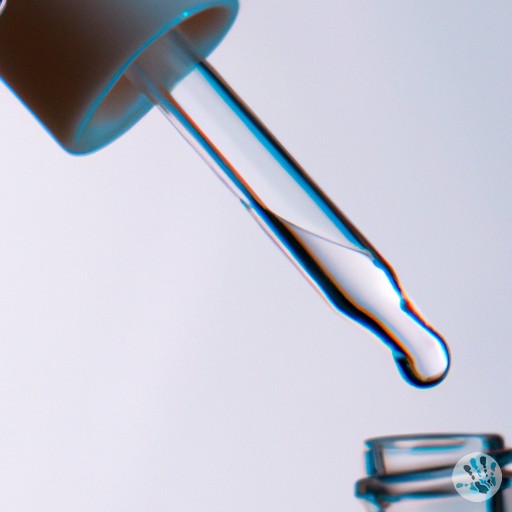
Pipette length is normally given as the length of the glass (or plastic) tube itself, from the top end that sits in the collar to the tip. It does not include the bulb or the collar. That is why the pipette length is always shorter than the total height of the closed bottle and close to, but usually slightly below, the height of the empty bottle.
The useful number is the gap between the pipette tip and the inside of the bottle base once the cap is fully closed. As a practical working range, a gap of roughly 3–8 mm is a good target for standard round dropper bottles: close enough to draw nearly all of the product, far enough to avoid contact when glass and closure tolerances add up.
The tolerances you need to account for
Glass bottles are formed at high temperature, so their height and base thickness vary slightly from batch to batch. Collars and bulbs also have their own tolerances. A pipette that is “exactly” the internal height of a sample bottle will touch the base on some percentage of a production run. Always leave a margin rather than matching to the millimetre.
Typical pipette lengths for DIN18 / GL18 bottles
Most European dropper bottles from 5 ml to 100 ml use the DIN18 (also called GL18) neck – an 18 mm nominal thread that allows bottles and dropper caps to be combined across a wide range of sizes. Because the neck is standardised, the variable that changes with volume is mainly bottle height, and therefore pipette length.
The pairings below are the standard combinations used in our assembled droppers for round DIN18 bottles:
| Όγκος φιάλης | Typical pipette length |
|---|---|
| 5 ml | 48 mm |
| 10 ml | 58 mm |
| 15 ml | 63 mm |
| 20 ml | 70 mm |
| 30 ml | 77 mm |
| 50 ml | 90 mm |
| 100 ml | 108 mm |
Treat this as a starting point, not a universal rule. These values assume standard round “Boston-style” or “Euro” dropper bottles. Other shapes change the picture.
When the standard table does not apply
- Squat or wide bottles – a 30 ml squat bottle can be noticeably shorter than a standard 30 ml bottle, so it may need a 15 ml or 20 ml pipette length.
- Tall, slim bottles – often need the next pipette length up.
- Thick-base or “heavy” glass – a decorative heavy base raises the internal floor of the bottle, so the pipette needs to be shorter than the external height suggests.
- Different closure styles – a child-resistant dropper or a closure with a taller collar can sit the pipette at a slightly different height than a standard tamper-evident cap. Re-check the fit when you switch closure type, even on the same bottle.
Straight tip, bent tip or graduated?
Length is not the only pipette choice:
- Straight tip – the default for oils, serums and tinctures. Easy to fill, easy to clean, predictable drop size.
- Bent (curved) tip – helps the user reach the corner of the base as the bottle empties. Useful for thicker formulas.
- Graduated (marked) pipettes – printed or etched volume marks help customers dose, which matters for CBD oils and food supplements where the label states a dose per ml. Check that the marks are positioned to be visible above the liquid level when the pipette is withdrawn.
For viscous products, consider pipette inner diameter together with length. A long, narrow pipette will be slow to fill with a thick oil, and the bulb may not create enough suction to draw a full dose.
A simple fit test before you order in volume
Before you commit to cartons or pallets, run a quick test with a small sample of the exact bottle and closure combination you will use:
- Close fully – thread the dropper cap onto an empty bottle to normal torque. It should close without resistance from below.
- Check the gap – hold the bottle up to the light (easier with clear glass; use a torch for amber) and estimate the tip-to-base gap. Aim for a few millimetres.
- Test with your product – fill to your nominal volume, then draw doses until the pipette cannot pick up any more. Note how much product remains.
- Test the tamper-evident ring – on TE and CRC/TE caps, confirm that the ring engages and breaks cleanly on first opening.
- Repeat on several bottles – a few samples from the same lot reveal tolerance problems that one bottle will not.
Συνηθισμένα λάθη που πρέπει να αποφεύγονται
- Choosing the pipette from the bottle’s nominal volume alone, without checking the actual bottle height.
- Changing bottle shape or glass supplier mid-project and keeping the old pipette length.
- Assuming a closure that fits the thread also fits the bottle height – DIN18 compatibility guarantees the thread, not the pipette length.
Ordering assembled droppers vs. separate components
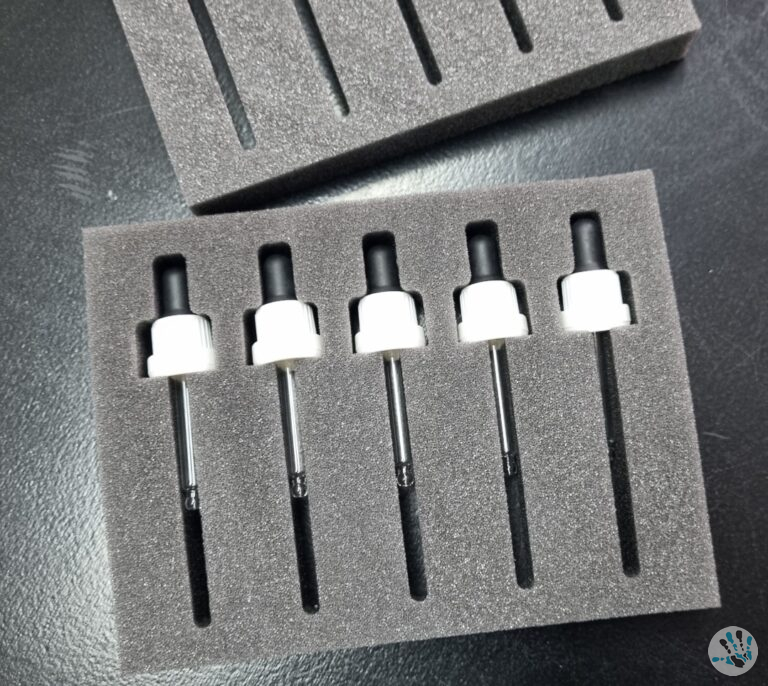
If you fill on a manual or semi-automatic line, ordering pre-assembled droppers (bulb, collar and pipette already joined) saves labour and removes one of the most common error points – mismatched components. If you need flexibility, for example several bottle sizes sharing one bulb and collar, separate Εξαρτήματα και μέρη let you combine elements yourself. Either way, specify bottle volume, neck (DIN18/GL18), pipette length, tip type and bulb material in your order.
Δείτε τα Σταγονόμετρα με δακτύλιο ασφαλείας και child-resistant tamper-evident droppers by bottle size, match them with φιαλίδια με σταγονόμετρο DIN18/GL18, or find individual pipettes and bulbs under parts & components. All products are listed with per-carton quantity pricing in the shop.
Συχνές ερωτήσεις
Can I use a 30 ml dropper in a 50 ml bottle?
It will thread onto the bottle if both use the DIN18/GL18 neck, but the pipette will be too short to reach the lower part of the bottle. The customer would not be able to use a significant part of the product, so choose the pipette length for the actual bottle.
What happens if the pipette is slightly too long?
The tip touches the base before the cap is fully closed. This can prevent proper sealing, stop the tamper-evident ring from engaging and cause glass pipettes to crack during capping or transport.
Is pipette length the same for amber and clear bottles?
Usually yes, if the bottles have the same shape and dimensions. The glass colour does not change pipette length, but bottle height and base thickness can differ between product lines, so check the fit when switching.
Do I need a different pipette for CBD oil or essential oils?
The length is determined by the bottle, not the product. The product affects other choices – graduated pipettes for dosing, glass rather than plastic for aggressive oils, and the right bulb material for chemical compatibility.