DIN18-tjekliste for kompatibilitet mellem dele til pipetteflasker og roll-ons
En pipette- eller roll-on-lukning er sjældent én del. Det er et lille system: flaskehals, prop eller wiper, hætte eller collar, pipettegummi, pipette eller kugle. Hver del kan være helt i orden alene og stadig fejle i kombination. Resultatet er en hætte, der ikke sidder korrekt, en pipette, der rører bunden, eller en prop, der løsner sig under transport.
Denne tjekliste er til købere, produktudviklere og produktionsledere, der vil bekræfte kompatibiliteten på papiret først og på en prøve dernæst. Den fokuserer på DIN18-halsudformningen, som er den standard, vi arbejder mest med, og på delene i vores Dele & komponenter .
Hvorfor opstår kompatibilitetsproblemer
De mest almindelige årsager er enkle:
- Dele bestilles fra forskellige leverandører, og ingen sammenligner dem side om side.
- Halsudformningen antages i stedet for at være bekræftet (for eksempel at “18 mm” betyder det samme alle steder).
- En komponent udskiftes af et kosmetisk hensyn, f.eks. en ny hættefarve, uden at pasformen kontrolleres igen.
- Produktet ændres (en tykkere olie eller en mere flygtig blanding), men lukningen forbliver den samme.
Ingen af disse er svære at forebygge. De kræver blot en fast rækkefølge af kontroller.
Trin 1: Bekræft halsudformningen
Start med flasken. Skriv halsudformningen ned, som den er angivet i flaskespecifikationen, ikke som man husker den. For DIN18-flasker skal alle lukningsdele specificeres til samme udformning. Hvis du bruger en anden eller specialfremstillet hals, skal du oplyse det i din forespørgsel, da standarddele muligvis ikke passer.
Notér også, hvordan lukningen skal tætne. Nogle lukninger tætner mod halsens kant, nogle med en indvendig prop, der presses ind i boringen, og nogle med begge dele. Dette påvirker, hvilke dele du har brug for, og hvordan de spiller sammen.
Hvad der skal noteres
- Betegnelse for halsudformning (DIN18 eller andet)
- Flaskens volumen og glasfarve
- Flaskens højde, hvilket har betydning for pipettens længde
- Om flasken er beregnet til en prop, en pipetteenhed eller en sprayer
Trin 2: Vælg doseringsfunktionen først
Beslut, hvordan produktet forlader flasken, før du vælger farve eller udformning. Funktionen bestemmer listen over dele:
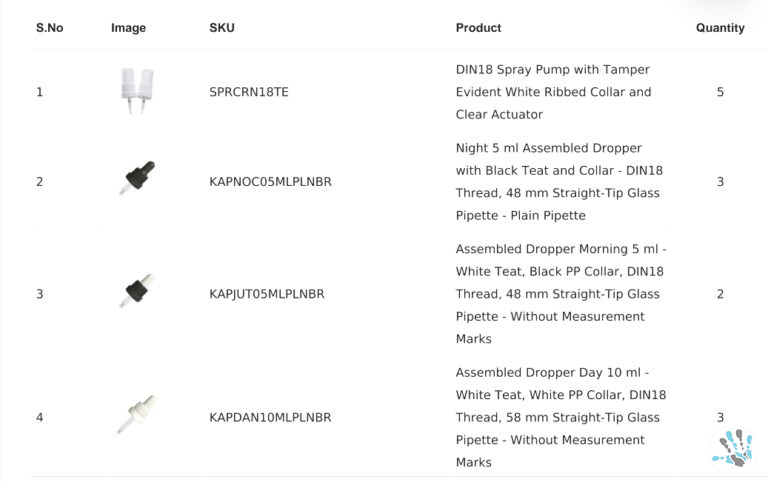
- Dosering dråbe for dråbe: pipettegummi, collar og pipette.
- Kontrolleret udhældning eller reduktion af åbningen: en indvendig prop eller wiper plus en hætte.
- Påføring på huden ved at køre hen over overfladen: en roll-on-prop med kugle og hætte.
- Fin forstøvning: en sprayfitting.
Hvis du stadig er i tvivl mellem formater, dækker vores artikel om valg af DIN18-prop efter anvendelse denne sammenligning. Her forudsætter vi, at funktionen er valgt, og fokuserer på at få delene til at passe sammen.

Trin 3: Kontrollér hver komponent i forhold til dens naboer
Tabellen nedenfor viser, hvad hver del skal passe til, og den fejl, vi oftest ser.
| Komponent | Skal passe til | Almindelig fejl |
|---|---|---|
| Flaske | Halsudformning, højde, volumen | At antage udformningen uden at kontrollere specifikationen |
| Prop eller wiper | Flaskens boring og hætten, der sidder over den | At skifte hætte uden at teste proppens sæde igen |
| Hætte eller collar | Halsgevind og pipettegummi eller prop under den | At bestille en udformning kun ud fra udseende |
| Sut | Collar-åbning og pipettetop; produktkompatibilitet | At ignorere, hvordan produktet påvirker materialet |
| Pipette | Flaskehøjde og pasform af pipettegummi | Pipette for lang eller for kort til flasken |
| Roll-on-kugleprop | Flaskehals og viskositet på fyldningen | Testing with water instead of the real product |
Step 4: Think about the product, not just the parts
Your formulation is part of the system. Oils, alcohol-based blends, essential oils and water-based serums behave differently against plastics and elastomers. Before approving a combination, ask:
- Is the teat material suitable for the liquid you fill? NBR, silicone and TPE respond differently to different liquids, so test with your actual formula.
- Does the product contain strong solvents or fragrance components that may soften or swell plastic parts?
- Is the liquid thin enough to leak around a plug, or thick enough to flow poorly through a roll-on ball seat?
We do not state chemical resistance data unless it is in the product specification, so the practical answer is always to run a compatibility test with your own product and your chosen parts.
Step 5: Roll-on sets, a worked example
Roll-on sets show why a combined check matters. A set such as the steel ball roll-on plug for DIN18 bottles with a transparent plug and black PP screw cap brings together a stainless steel ball, a transparent plug and a screw cap. The plug holds the ball and seats in the neck, and the cap closes over it.
Before ordering a carton, check:
- That the bottle is a DIN18 finish.
- That the fill is suitable for a ball applicator. Very thin liquids may run more freely than you want.
- That the cap color suits the bottle and label design. The same set is offered with different cap colors, so match it to your artwork early.
- That the cap closes fully and feels consistent across several units, not only one sample.
Vores GuardSeal plug range lists the other plug types if a roll-on is not the right format for your product.
Step 6: Check pipette and bottle height together
Pipettes are the part most often mismatched to the bottle. If the tip rests on the bottom, it can limit draw-up and make the last portion of product hard to reach. If it is too short, the tube may not reach the liquid as the level drops. Always measure the sealed assembly with the bottle upright rather than comparing two numbers on paper. Our glaspipetter are available in more than one format, so pick based on the bottle you actually use.
Step 7: Run a small pilot before the full order
A short pilot catches most of what a spec sheet cannot. A reasonable routine:
- Assemble five to ten complete units with the exact parts you plan to order.
- Fill them with the real product, not a stand-in.
- Cap with the torque or pressure your line will use.
- Store some upright and some on their sides for a few days, then inspect for seepage at the neck.
- Dispense from each unit and check that the function is consistent.
- Ship a few units in your normal carton and check them again on arrival.
Record the results with part descriptions, so a reorder months later uses the same combination.
Keep a simple parts record
Once a combination works, document it. A one-page record is enough:
- Bottle description and neck finish
- Every component with its description and color
- Fill product and batch used in the test
- Date of the test and the person who approved it
When any part changes, repeat the pilot. It takes a short time compared with the cost of a recalled batch.
FAQ
Are all DIN18 parts interchangeable?
They are designed around the same neck finish, but you should still confirm fit with a sample. Differences in plug design, collar shape and cap style can affect how parts work together.
Can I change only the cap color on an existing assembly?
Usually yes if the cap model stays the same, but check that the new batch seats and seals the same way. If the cap style changes, treat it as a new combination and test it.
Should I test with water or my actual product?
Use your actual product. Viscosity, solvents and fragrance components can change how a plug seals, how a ball rolls and how an elastomer behaves.
Kan jeg få prøver, før jeg bestiller en karton?
Yes. Contact us with your bottle details and intended use, and we can advise on a combination and arrange samples where available.
Ready to compare parts? Gå på opdagelse i butikken or contact us for samples and advice on a DIN18 combination that fits your product.