Kompatibilitetschecklista för DIN18-delar till pipettflaskor och roll-ons
En pipett- eller roll-on-förslutning är sällan en enda del. Det är ett litet system: flaskhals, plugg eller wiper, lock eller krage, gummibulb, pipett eller kula. Varje del kan vara helt i sin ordning på egen hand och ändå fungera dåligt i kombination. Resultatet kan bli ett lock som inte sitter fast, en pipett som når botten eller en plugg som lossnar under transport.
Den här checklistan är för inköpare, produktutvecklare och produktionsansvariga som vill bekräfta kompatibiliteten på papper först och på prov sedan. Den fokuserar på DIN18-halsutformningen, som är den standard vi arbetar mest med, och på delarna i vårt Delar & komponenter .
Varför kompatibilitetsproblem uppstår
De vanligaste orsakerna är enkla:
- Delar beställs från olika leverantörer och ingen jämför dem sida vid sida.
- Halsutformningen antas i stället för att bekräftas (till exempel att “18 mm” tolkas som samma sak överallt).
- En komponent byts ut av estetiska skäl, till exempel en ny lockfärg, utan att passformen kontrolleras igen.
- Produkten ändras (en tjockare olja eller en mer flyktig blandning) men förslutningen förblir densamma.
Ingen av dessa är svåra att förebygga. De kräver bara en fast ordning för kontrollerna.
Steg 1: Bekräfta halsutformningen
Börja med flaskan. Skriv ned halsutformningen så som den anges i flaskspecifikationen, inte så som man minns den. För DIN18-flaskor måste alla förslutningsdelar specificeras för samma utformning. Om du använder en annan eller specialanpassad hals ska du ange det i din förfrågan, eftersom standarddelar kanske inte passar.
Notera även hur förslutningen är avsedd att tätas. Vissa förslutningar tätar mot halsens kant, andra med en inre plugg som trycks in i mynningen och vissa med båda. Detta påverkar vilka delar du behöver och hur de samverkar.
Det här ska du dokumentera
- Beteckning för halsutformning (DIN18 eller annan)
- Flaskans volym och glasfärg
- Flaskans höjd, vilket är avgörande för pipettens längd
- Om flaskan är avsedd för en plugg, ett pipettaggregat eller en sprayer
Steg 2: Välj dosfunktion först
Bestäm hur produkten ska lämna flaskan innan du väljer någon färg eller ytbehandling. Funktionen styr delförteckningen:
- Droppvis dosering: gummibulb, krage och pipett.
- Kontrollerad hällning eller öppningsreducering: en innerplugg eller wiper samt ett lock.
- Applicering på huden genom rullning: en roll-on-plugg med kula och lock.
- Fin sprej: ett sprayaggregat.
Om du fortfarande funderar mellan olika format täcks jämförelsen i vår artikel om hur du väljer en DIN18-plugg efter användning. Här utgår vi från att funktionen redan är vald och fokuserar på att få delarna att passa ihop.
Steg 3: Kontrollera varje komponent mot dess grannar
Tabellen nedan visar vad varje del måste passa ihop med och det misstag vi oftast ser.
| Komponent | Måste passa ihop med | Vanligt misstag |
|---|---|---|
| Flaska | Halsutformning, höjd, volym | Att anta utformningen utan att kontrollera specifikationen |
| Plugg eller wiper | Flaskans mynning och locket som sitter över den | Att byta lock utan att testa pluggens säte på nytt |
| Lock eller krage | Halsgängan och gummibulben eller pluggen under | Att beställa en ytbehandling enbart för utseendets skull |
| Dutt | Kragöppning och pipettoppen; produktkompatibilitet | Att ignorera hur produkten påverkar materialet |
| Pipett | Flaskhöjd och bulbpassform | Pipetten för lång eller för kort för flaskan |
| Roll-on-kulplugg | Flaskhals och produktens viskositet | Testing with water instead of the real product |
Step 4: Think about the product, not just the parts
Your formulation is part of the system. Oils, alcohol-based blends, essential oils and water-based serums behave differently against plastics and elastomers. Before approving a combination, ask:
- Is the teat material suitable for the liquid you fill? NBR, silicone and TPE respond differently to different liquids, so test with your actual formula.
- Does the product contain strong solvents or fragrance components that may soften or swell plastic parts?
- Is the liquid thin enough to leak around a plug, or thick enough to flow poorly through a roll-on ball seat?
We do not state chemical resistance data unless it is in the product specification, so the practical answer is always to run a compatibility test with your own product and your chosen parts.
Step 5: Roll-on sets, a worked example
Roll-on sets show why a combined check matters. A set such as the steel ball roll-on plug for DIN18 bottles with a transparent plug and black PP screw cap brings together a stainless steel ball, a transparent plug and a screw cap. The plug holds the ball and seats in the neck, and the cap closes over it.
Before ordering a carton, check:
- That the bottle is a DIN18 finish.
- That the fill is suitable for a ball applicator. Very thin liquids may run more freely than you want.
- That the cap color suits the bottle and label design. The same set is offered with different cap colors, so match it to your artwork early.
- That the cap closes fully and feels consistent across several units, not only one sample.
Våra GuardSeal plug range lists the other plug types if a roll-on is not the right format for your product.
Step 6: Check pipette and bottle height together
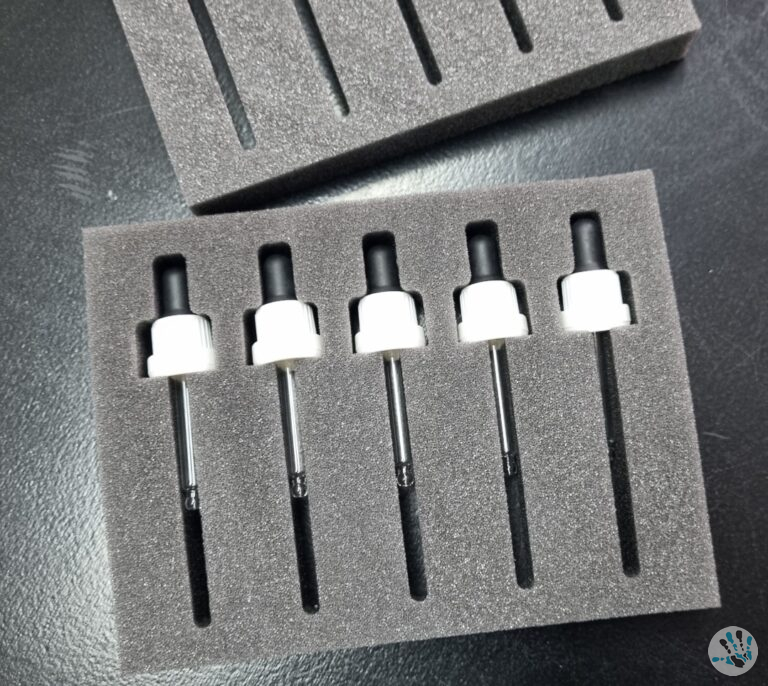
Pipettes are the part most often mismatched to the bottle. If the tip rests on the bottom, it can limit draw-up and make the last portion of product hard to reach. If it is too short, the tube may not reach the liquid as the level drops. Always measure the sealed assembly with the bottle upright rather than comparing two numbers on paper. Our glaspipetter are available in more than one format, so pick based on the bottle you actually use.
Step 7: Run a small pilot before the full order
A short pilot catches most of what a spec sheet cannot. A reasonable routine:
- Assemble five to ten complete units with the exact parts you plan to order.
- Fill them with the real product, not a stand-in.
- Cap with the torque or pressure your line will use.
- Store some upright and some on their sides for a few days, then inspect for seepage at the neck.
- Dispense from each unit and check that the function is consistent.
- Ship a few units in your normal carton and check them again on arrival.
Record the results with part descriptions, so a reorder months later uses the same combination.
Keep a simple parts record
Once a combination works, document it. A one-page record is enough:
- Bottle description and neck finish
- Every component with its description and color
- Fill product and batch used in the test
- Date of the test and the person who approved it
When any part changes, repeat the pilot. It takes a short time compared with the cost of a recalled batch.
Vanliga frågor
Are all DIN18 parts interchangeable?
They are designed around the same neck finish, but you should still confirm fit with a sample. Differences in plug design, collar shape and cap style can affect how parts work together.
Can I change only the cap color on an existing assembly?
Usually yes if the cap model stays the same, but check that the new batch seats and seals the same way. If the cap style changes, treat it as a new combination and test it.
Should I test with water or my actual product?
Use your actual product. Viscosity, solvents and fragrance components can change how a plug seals, how a ball rolls and how an elastomer behaves.
Kan jag få prover innan jag beställer en kartong?
Yes. Contact us with your bottle details and intended use, and we can advise on a combination and arrange samples where available.
Ready to compare parts? Bläddra i butiken or contact us for samples and advice on a DIN18 combination that fits your product.